

Signal integrity starts with the links between your components. Browse our curated selection of British-engineered Hi-Fi cables and power accessories from The Chord Company — covering everything from entry-level C-series and Leyline leads to Tuned ARAY interconnects, 48Gbps 8K HDMI cables, and PowerHAUS mains distribution blocks.

An audio cable connects two components in a hi-fi system and is defined by its conductor material and geometry, shielding, and insulation — properties that determine how much a signal changes in transit. How much a specific cable affects the result depends on where it sits in the chain: a moving-magnet phono cartridge’s recommended load capacitance, a long or high-current speaker run, and a digital interface’s bandwidth requirement are the connections where cable specification is most likely to matter.
Can you actually hear the difference between a cable that costs €30 and one that costs €600? It’s one of the longest-running arguments in hi-fi, and unlike most audiophile debates, part of it can be settled with a multimeter rather than an opinion.
Every cable in a system does the same basic job: carry a signal from one component to another while changing it as little as possible. How much a given cable can affect that signal depends on where it sits in the chain. A moving-magnet phono cartridge, for instance, is designed against a specific recommended load capacitance, and a cable that sits well outside that figure can measurably shift its frequency response — a real, testable effect, not a matter of taste. A long speaker cable driving a low-impedance loudspeaker is more exposed to a cable’s own resistance than a short run into an easy load. A USB or HDMI cable, by contrast, is carrying encoded data that’s typically buffered and re-clocked downstream, so the more relevant question is usually whether the cable meets the bandwidth a format requires — an HDMI cable rated for 48Gbps either supports real 8K/60Hz and 4K/120Hz signals or it doesn’t, regardless of price.
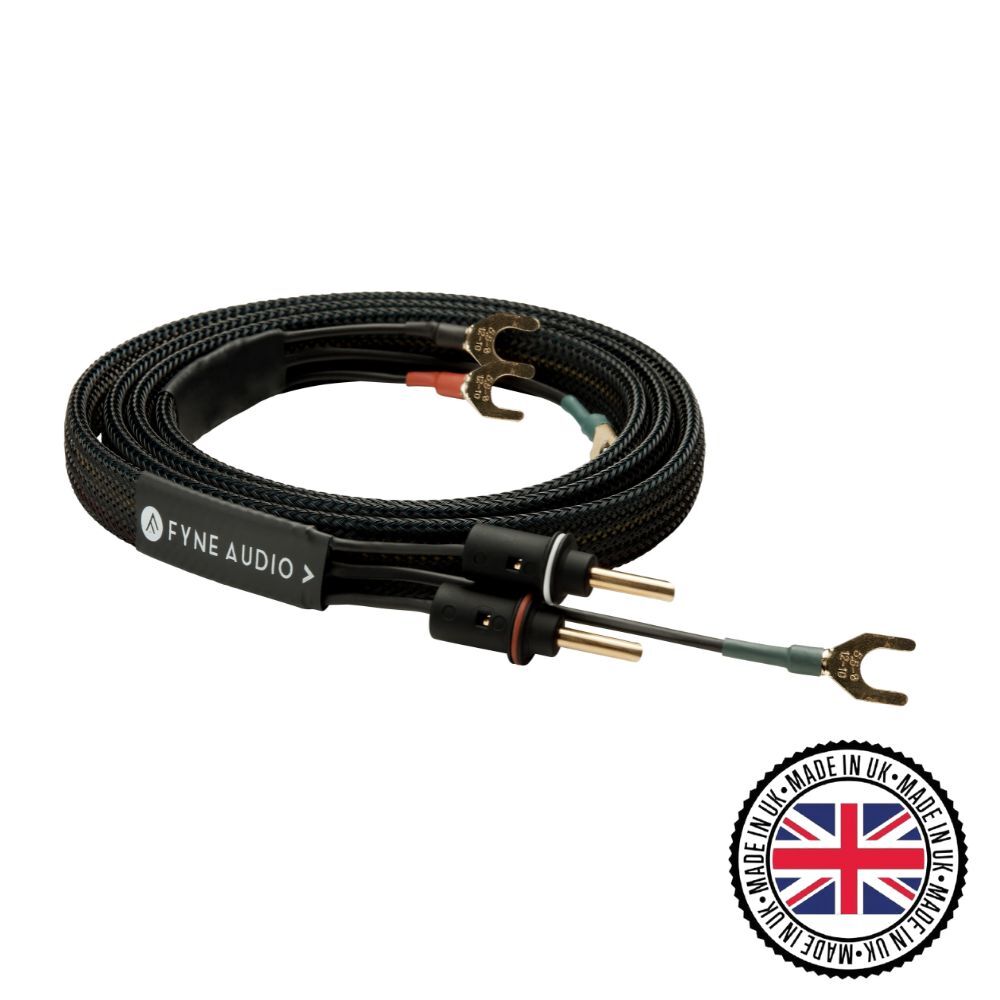
This category brings together Chord Company’s cable ranges — C-series and Leyline at the accessible end, through Shawline and Shawline X, up to Clearway and Clearway X — spanning speaker cables, RCA and mini-jack interconnects, USB, HDMI, Toslink optical and network cables, mains power cables, and dedicated subwoofer cables. Alongside it sits Fyne Audio’s SC1, a specialised interconnect built for the SuperTrax and S-Trax supertweeter modules fitted to some of Fyne Audio’s own loudspeakers, rather than a general-purpose cable.
It’s worth clearing up a common point of confusion first: Chord Company and Chord Electronics, also both sold here, are separate British companies that happen to share a name. Chord Electronics builds DACs and amplifiers; Chord Company builds cables. Neither owns the other.
Below, we walk through what genuinely differs between cables at a technical level, the main cable types stocked in this category, and how to match a range to your system without paying for a difference a given connection won’t expose.
It depends on the connection. At a moving-magnet phono cartridge’s input, cable capacitance has a documented, measurable effect on frequency response; moving-coil cartridges are far less sensitive to this, since their loading is specified as a resistance rather than a capacitance. Over a long or demanding speaker run, cable resistance is a real factor. For most digital cables, the more relevant question is whether the cable meets the format’s bandwidth requirement rather than whether it ‘sounds’ different. Claims for mains and power cables are the least verifiable of the group and worth the most scepticism.
A speaker cable carries the amplified, high-current output from an amplifier to a loudspeaker and needs to handle significant current with low resistance. An interconnect carries a much lower-level line signal between source components, preamplifiers and amplifiers, where shielding against noise typically matters more than raw current capacity.
No — it needs to meet the specification for what you’re asking it to carry. An HDMI cable rated for 48Gbps supports real 8K/60Hz or 4K/120Hz signals; one that isn’t, won’t, regardless of price. Beyond meeting the relevant spec reliably, higher-tier digital cables mainly add build quality and connector durability rather than a different signal.
Yes — a subwoofer typically connects via a dedicated RCA cable carrying only the low-frequency (LFE) feed from a preamplifier or AV receiver, which is a different job from the higher-current speaker cable used for main loudspeakers.
Gauge and fuse rating are legitimate, measurable factors in how safely a cable delivers current to a component. Beyond that, audible improvement claims are the most contested part of the cable debate and worth treating carefully — a genuine noise or hum problem is usually a specific grounding or interference issue to diagnose, rather than something a premium mains cable reliably resolves by itself.
It refers to a specific conductor geometry — Tuned or Super ARAY, depending on the range — engineered to reduce a type of signal loss inherent to ordinary stranded-wire construction. It was introduced through Chord Company’s Signature and Sarum ranges and now appears in other tiers as ‘X ARAY’ variants.
© 2026 MGY Europe. All rights reserved.